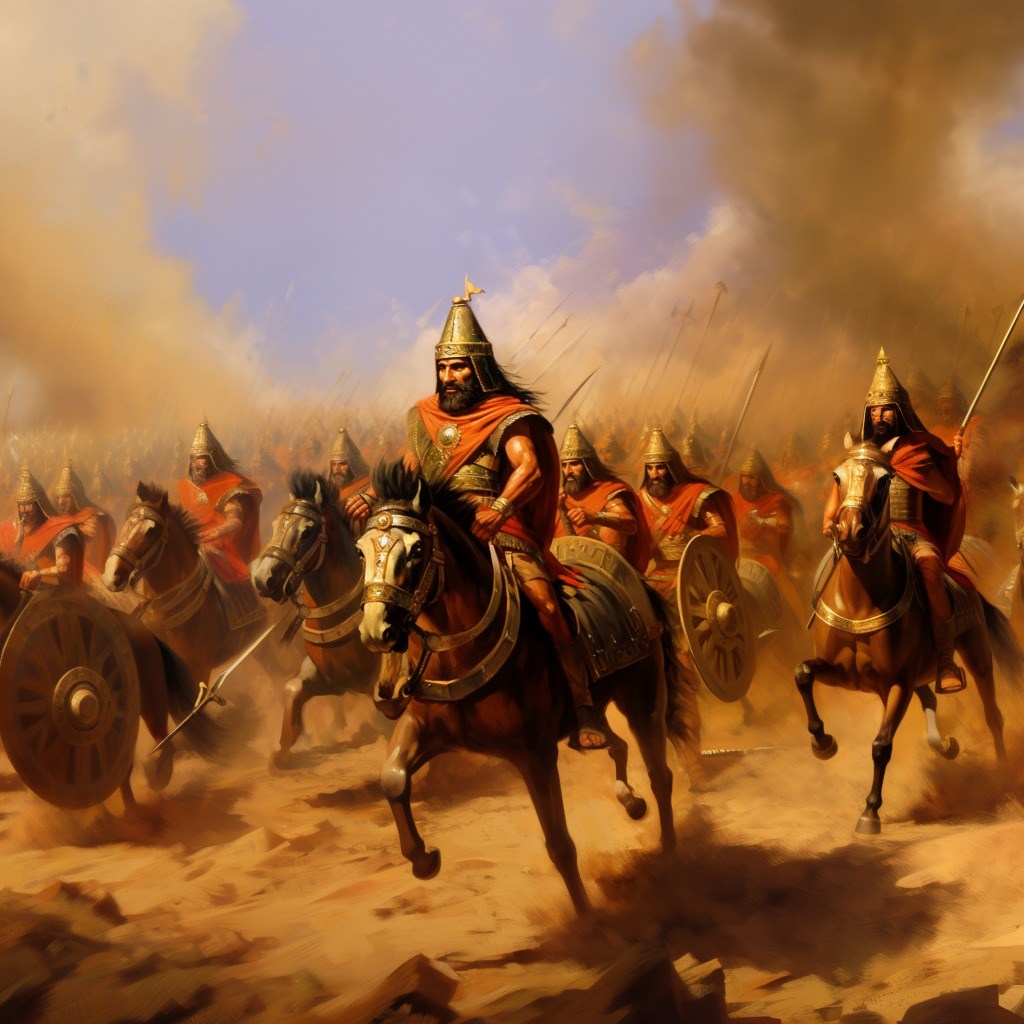
Assyria enters the record only within the Isaiah chapters that Nephi quotes from the brass plates, where it is the empire God raises against the house of Israel. Called “the rod of mine anger” (2 Ne. 20:5), Assyria is sent to punish rulers who decree unrighteous decrees, turn away the needy from judgment, and prey on widows and the fatherless (2 Ne. 20:1). After the Lord finishes his work on Mount Zion and Jerusalem, he turns to punish the king of Assyria for the pride of his own heart (2 Ne. 20:12).
The invasion of Judah is foretold as a flood: the Lord brings up the king of Assyria like the strong waters of a river overflowing all its banks (2 Ne. 18:7), passing through Judah and reaching “even to the neck” (2 Ne. 18:8). Zion is told not to fear the Assyrian, who smites with a rod after the manner of Egypt, because the indignation will soon cease and the Lord will stir up a scourge against him as in the slaughter of Midian at the rock of Oreb (2 Ne. 20:24-26). The burden is to be lifted from Israel’s shoulder and the yoke broken from off its neck (2 Ne. 20:27).
The army’s march is named town by town, through Aiath, Migron, Michmash, Geba, and Gibeah of Saul, halting at Nob, where it shakes its hand against the hill of Jerusalem (2 Ne. 20:28, 32). There the Lord lops the bough, hews down the high ones, and humbles the haughty (2 Ne. 20:33). Assyria is also named among the lands from which the Lord will gather the remnant of his people a second time, with a highway prepared for their return (2 Ne. 21:11, 16). The Lord swears that he will bring the Assyrian into his land and tread him under foot on his mountains, after which the yoke and burden depart from Israel (2 Ne. 24:25).