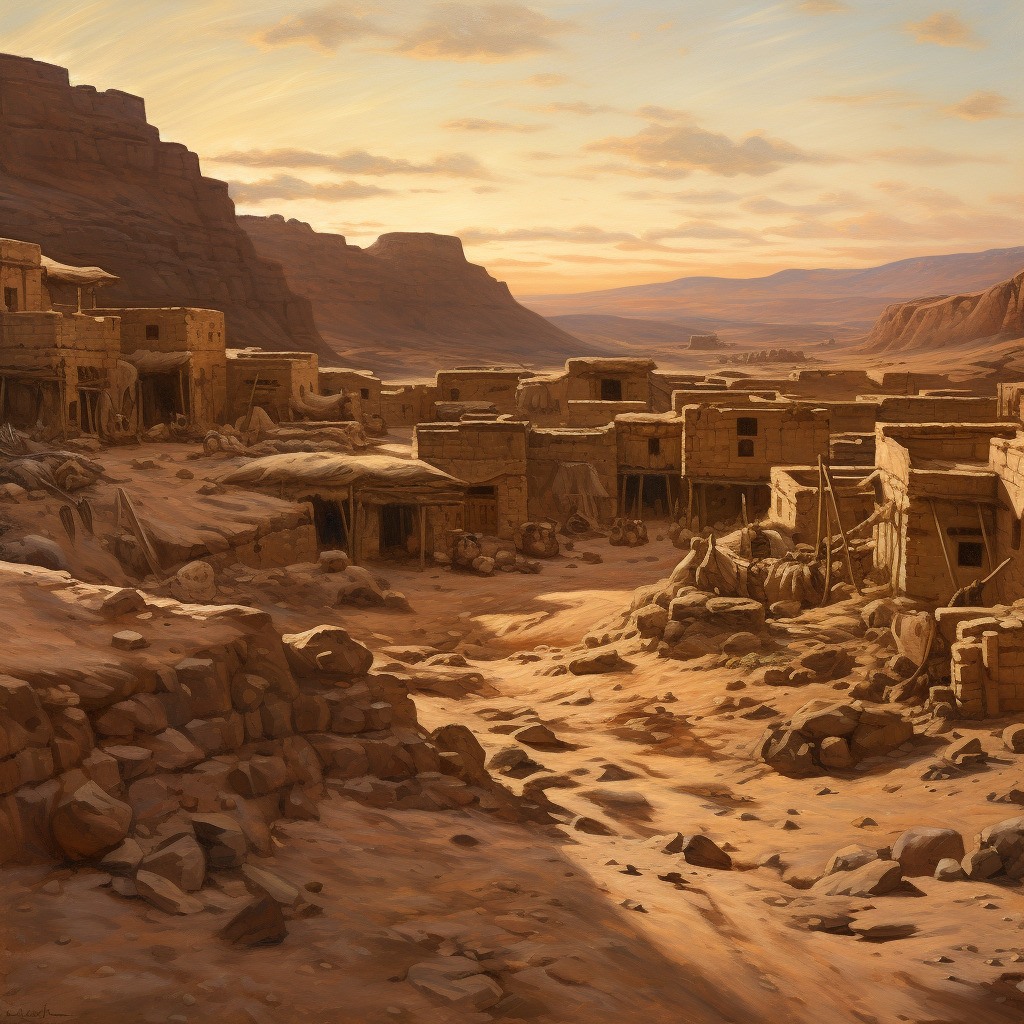
Nahom was the place along Lehi1’s route through the Arabian peninsula where Ishmael died and was buried (1 Nephi 16:34). After his death, Ishmael’s daughters mourned the loss of their father and their hardships in the wilderness, and murmured against Lehi for bringing them out of Jerusalem, wanting to return there (1 Nephi 16:34–36). Laman1 then urged Lemuel and the sons of Ishmael to kill Lehi and Nephi1, claiming Nephi lied about the Lord speaking to him in order to set himself up as ruler (1 Nephi 16:37–38). The rebellion ended when the voice of the Lord chastened them, after which they repented and were again provided with food (1 Nephi 16:39).
The name Nahom has been linked to the Hebrew terms nāham, “groan,” and nāḥam, denoting sorrow or self-consolation. It has been proposed that Nahom corresponds to the present-day Nihm region in Yemen. Altars dating to the seventh century B.C. and inscribed with dedications by a man named Bicathar of the Nihm tribe have been found there, and both names share the consonants NHM; the Nihm tribe has long resided near Wadi Jawf.
From Nahom the party traveled nearly eastward (1 Nephi 17:1) to a place they named Bountiful for its abundant fruit and wild honey (1 Nephi 17:1–5). Bountiful has been identified with the Dhofar region on the southern coast of Oman, the one stretch of the Arabian seashore matching Nephi’s description of an area with fruit, honey, and timber able to sustain people and animals (1 Nephi 17:5; 18:1).
The party spent eight years in the wilderness (1 Nephi 17:4). The leg from the first camp to Nahom, about 1,150 miles, could have been covered in a year or less, which places most of the eight years between Nahom and Bountiful. Nephi gives few specifics of the route, such as the location of the mountain crossing he mentions. His report of successful hunting points to adequate cover (1 Nephi 16:14–15), and the births of the first children are noted only after the eastward turn from Nahom (1 Nephi 17:1).