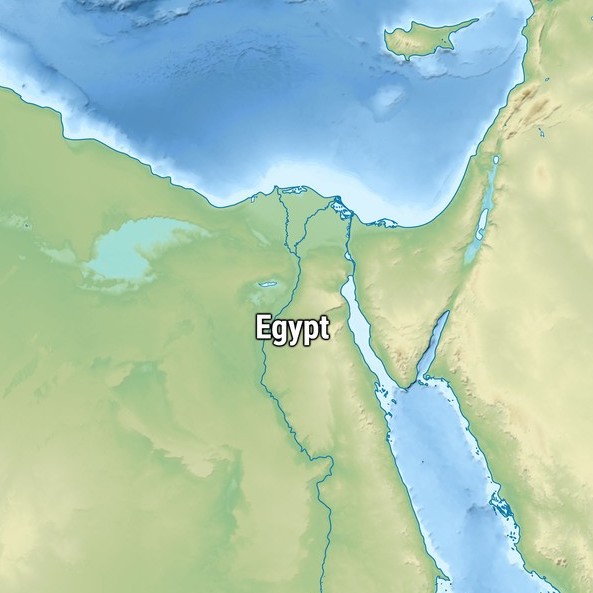
Egypt enters the record chiefly through the Israelite exodus, cited repeatedly as the act by which the Lord brought the house of Israel out of bondage. The text names this deliverance in Nephi’s writing (1 Nephi 17:40; 1 Nephi 19:10; 1 Nephi 5:15), in the Isaiah passages Nephi quotes (2 Nephi 20:24,26; 2 Nephi 21:11,16), in Nephi’s own testimony of Christ (2 Nephi 25:20), in a prophecy of Lehi naming Moses as the deliverer (2 Nephi 3:10), in King Limhi’s address (Mosiah 7:19), and in Alma’s account of his conversion (Alma 36:28). Several of these passages tie the exodus to specific details: the crossing of the Red Sea on dry ground (Mosiah 7:19), the drowning of the Egyptians in that sea (Alma 36:28; Helaman 8:11), and the feeding with manna in the wilderness (Mosiah 7:19). Beyond simple citation, Nephi also deploys the exodus as a typological argument: in 1 Nephi 17:23-43 he rehearses the Egypt deliverance at length, drawing an explicit parallel between Israel’s wilderness hardships and the Lehite journey, and pressing his brothers to acknowledge that the same God who led Israel out of Egypt had now led their own family through the wilderness — so that the exodus becomes the warrant by which the Lehite journey is recognized as a genuine covenant deliverance. Alma employs the same move in his conversion testimony, closing with a citation of the Egypt deliverance alongside his own experience of being brought out of bondage (Alma 36:28).
Egypt also figures in the lineage of Lehi, who was a descendant of Joseph, the son of Jacob who was sold into Egypt by his brethren and there preserved his father’s household from famine (1 Nephi 5:14; 2 Nephi 3:4; Alma 10:3; Ether 13:7). Joseph brought his father Jacob down into Egypt, where Jacob died; from that line the Lord later brought a remnant of Joseph’s seed out of Jerusalem (Ether 13:7). The descendants of Israel grew in Egyptian territory and were enslaved before the exodus under Moses.
Egypt is further connected to the record through language. Nephi wrote in a script combining the learning of the Jews and the language of the Egyptians (1 Nephi 1:2), Lehi could read the engravings on the plates of brass because he had been taught the language of the Egyptians (Mosiah 1:4), and Moroni states that the record was written in characters called reformed Egyptian, handed down and altered over time (Mormon 9:32).